 EN
EN

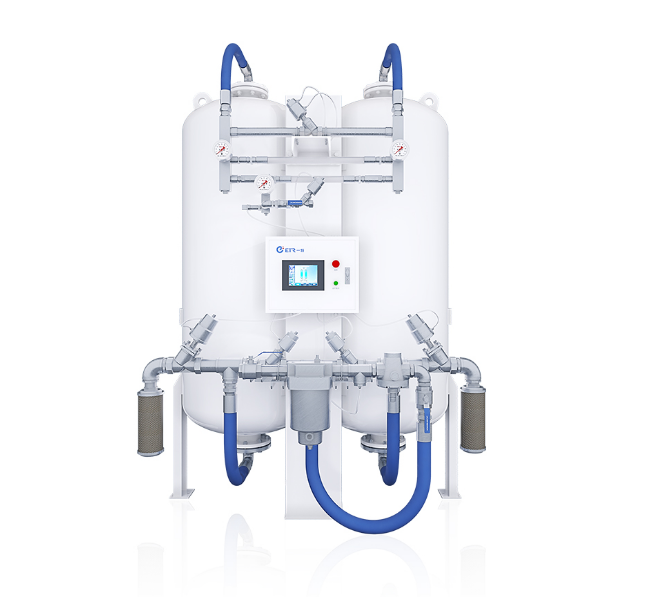
How an Oxygen Making Machine Works: PSA Technology for Medical-Grade Oxygen
Pressure Swing Adsorption (PSA) Explained: Turning Ambient Air into 90–95% Pure Oxygen
A medical-grade oxygen making machine uses Pressure Swing Adsorption (PSA) to extract oxygen from ambient air—delivering 93% ± 3% purity, which meets international medical gas standards. The process starts with an air compressor drawing in outside air and passing it through multi-stage filters that remove dust, moisture, and oil vapors. The clean, pressurized air then enters a vessel packed with zeolite molecular sieves. These sieves selectively adsorb nitrogen under pressure while allowing oxygen and argon to pass through as product gas. Once saturated, the vessel is depressurized to vent nitrogen harmlessly into the atmosphere—regenerating the sieve for the next cycle. Because two vessels operate in alternating adsorption and desorption phases, oxygen production is continuous and uninterrupted. This on-site generation eliminates cylinder logistics and ensures reliable, point-of-use supply.
Meeting ISO 8573-1 and NFPA 99 Standards: Purity, Flow Rate, and Safety Assurance
Clinical acceptance of an oxygen making machine hinges on compliance with ISO 8573-1 and NFPA 99—the globally recognized benchmarks for medical gas quality and safety. ISO 8573-1 defines purity classes for airborne contaminants; a well-designed PSA system achieves Class 1.2.1 for particles and ensures zero liquid water through integrated filtration and drying. NFPA 99 mandates reliability in flow delivery, alarm responsiveness, and system redundancy—requiring generators to sustain rated output (e.g., 50–100+ LPM) across ICUs, ORs, and wards without pressure drop or purity loss. Built-in safeguards—including automatic switchover between dual vessels, low-oxygen alarms, and emergency reserve interfaces—ensure uninterrupted care during maintenance or unexpected demand surges. Third-party validation and routine performance audits confirm ongoing adherence, reinforcing trust in clinical decision-making.
Eliminating Cylinder Dependence: Operational, Economic, and Safety Benefits of an Oxygen Making Machine
An oxygen making machine transforms hospital operations by replacing high-pressure cylinder logistics with quiet, moderate-pressure on-site generation. Staff no longer manage inventory tracking, delivery scheduling, or manual handling of heavy tanks—freeing clinical and support teams to prioritize patient care. Storage space previously occupied by cylinder racks becomes available for clinical expansion or workflow optimization. Critically, eliminating stored compressed oxygen reduces fire and explosion risk significantly, aligning with facility safety protocols. According to the World Health Organization, PSA-generated oxygen can cost 60–80% less than cylinder-supplied oxygen—driven by savings on rental fees, transport, handling labor, and administrative overhead. With electricity as the primary input, operational expenses become predictable and scalable.
Case Evidence: 300-Bed Hospital Cuts Cylinder Orders by 92% After PSA Deployment
A 300-bed hospital fully transitioned from cylinder-based oxygen to a PSA oxygen making machine—and reduced cylinder orders by 92% within its first year. Daily production reliably met peak ICU, ED, and ward demands without interruption. Operational costs fell by 30%, primarily from eliminating cylinder rental, transport, and logistics management. Clinicians reported zero supply-related disruptions, while staff noted fewer musculoskeletal injuries linked to tank handling. Inventory reconciliation and reorder workflows were retired entirely. This real-world implementation confirms that a properly sized and validated PSA system delivers not only economic return but also measurable gains in clinical resilience, staff efficiency, and patient safety.
Continuous and Resilient Oxygen Supply: Uptime, Scalability, and Clinical Reliability
Modern PSA systems achieve >99.5% operational uptime—supported by redundant components including dual compressors, fail-safe valves, and intelligent controllers that auto-switch between vessels during service. If one module requires maintenance, the secondary unit maintains full output without affecting patient care. Adaptive flow technology enables real-time response to demand fluctuations: when ventilators activate simultaneously in the ICU or trauma cases surge in the ED, the oxygen making machine increases output dynamically—no reconfiguration needed. Consistent pressure and purity are maintained even under peak load, preventing pipeline starvation risks associated with delayed cylinder changes. Remote monitoring dashboards provide live visibility into flow, purity, and system health—ensuring continuous compliance with clinical standards and enabling proactive maintenance. For hospitals pursuing energy-efficient, future-ready infrastructure, this level of reliability forms the foundation of a truly self-sufficient medical gas system.
Integrating an Oxygen Making Machine Into Hospital Infrastructure: Sizing, Placement, and Future-Proofing
Selecting the right capacity for a PSA oxygen making machine requires precise analysis of departmental oxygen demand—not theoretical maximums. ICUs drive high-flow, continuous requirements for ventilators and life support; EDs present sharp, unpredictable peaks; general wards need steady, lower-volume supply. Overengineering inflates capital expense, energy use, and long-term maintenance complexity. Instead, base sizing on validated historical consumption data and projected growth, using modular PSA units that allow incremental capacity expansion as needs evolve. Strategic placement near high-demand zones minimizes pipeline losses—but must account for ventilation, service access, acoustics, and floor loading. Redundancy should be intentional: parallel units or integrated cylinder backup provide failover assurance without requiring oversized primary systems. This approach ensures clinical readiness today—and adaptability tomorrow.
Table of Contents
-
How an Oxygen Making Machine Works: PSA Technology for Medical-Grade Oxygen
- Pressure Swing Adsorption (PSA) Explained: Turning Ambient Air into 90–95% Pure Oxygen
- Meeting ISO 8573-1 and NFPA 99 Standards: Purity, Flow Rate, and Safety Assurance
- Eliminating Cylinder Dependence: Operational, Economic, and Safety Benefits of an Oxygen Making Machine
- Case Evidence: 300-Bed Hospital Cuts Cylinder Orders by 92% After PSA Deployment
- Continuous and Resilient Oxygen Supply: Uptime, Scalability, and Clinical Reliability
- Integrating an Oxygen Making Machine Into Hospital Infrastructure: Sizing, Placement, and Future-Proofing

